
A roofing system depends on more than shingles, panels, or membrane. The places where the roof meets a wall, chimney, parapet, edge, or drain all need metal components that fit the building and help move water where it needs to go. Standard parts do not always fit those conditions. Custom sheet metal gives roofing contractors a way to order the right piece for the job instead of cutting, reshaping, or trying to make a stock product work in the field.
Since 1962, Thompson-Mathis Metal has fabricated sheet metal products for roofing contractors, general contractors, builders, and other construction professionals throughout Dallas-Fort Worth and beyond. Our team can work from plans, shop drawings, sketches, field measurements, or an existing piece to produce both common roofing components and more specialized parts.
No two roofs are exactly alike. Wall thicknesses change and parapets vary in size, while roof pitches and drainage layouts create different conditions from one building to another. Even two similar roofs may need different flashing or edge-metal dimensions based on the roofing system below them. On repair and reroofing projects, contractors may also need to match metal that was installed years ago and is no longer available as a standard product.
Custom fabrication gives contractors more control over how each piece fits and performs. Instead of adapting the roof to the metal, the metal can be made around the actual jobsite conditions. That can mean less cutting and bending in the field, fewer unnecessary seams, and less time trying to make mismatched components work together. It can also produce a more finished result in highly visible areas such as fascia, coping, and exterior drainage systems.
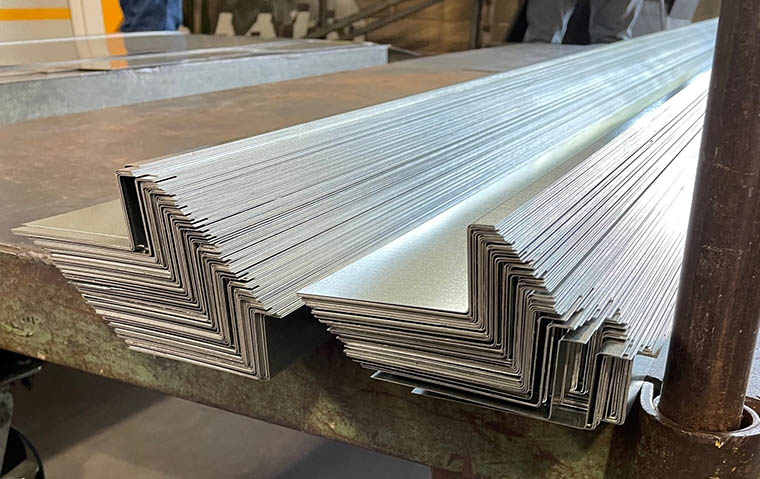
Flashing protects some of the most vulnerable parts of a roof and is used wherever roofing meets another surface or changes direction. That includes walls and chimneys as well as valleys, roof edges, and penetrations for pipes or equipment. The basic job is straightforward–keep water moving over and away from the joint instead of giving it a place to enter the roofing system–but the challenge is getting the profile to match the condition.
Thompson-Mathis Metal fabricates custom flashing from drawings, sketches, field measurements, or samples. Contractors can order common profiles such as counter flashing, step flashing, valley flashing, and drip edge, but they are not limited to standard dimensions. If an existing building has an unusual profile, we can often use the original piece or field measurements to reproduce it, which can be especially valuable on repairs and reroofs where replacing the surrounding construction just to accommodate a standard flashing profile would add unnecessary work.

The roof edge is both functional and highly visible. Edge metal helps protect the perimeter of the roofing system, while fascia and gravel stops create a finished transition between the roof and building exterior. When these pieces are too short, too deep, or otherwise poorly matched to the roof, contractors can end up spending time trimming or modifying them before installation can even begin.
Length is another important factor. The 21-foot JORNS hydraulic brake at Thompson-Mathis Metal allows us to form many flashing, fascia, and edge-metal profiles in longer sections. Where the material and installation conditions allow, that can mean fewer individual pieces for a roofing crew to handle, align, and join across a long roof edge. Fewer seams reduce field work and create a cleaner finished line, particularly on commercial buildings where the roof edge may extend across a large, highly visible elevation.

Parapet walls are common on commercial and low-slope roofs. Because the top of the wall is exposed to weather, it needs a cap that protects the wall assembly below. Metal coping provides that protection while also creating the finished upper edge that can be seen from the exterior of the building.
A long commercial parapet may look uniform from the ground, but contractors can encounter several different conditions once they begin measuring it. Wall widths may change, corners and elevation changes require different pieces, and existing construction can make one section different from the next. Thompson-Mathis can fabricate the straight runs along with the special pieces needed to finish corners and transitions. Coordinating those pieces before they reach the roof helps the crew spend more time installing and less time trying to remake the system in the field.

Many commercial and low-slope roofs move water through the parapet instead of over the roof edge. A scupper creates the opening that allows water to leave the roof, while a conductor head or collector box receives that water on the outside of the building and directs it into the downspout below. For the system to work well, those pieces need to line up with each other. The scupper has to fit the roof and wall opening, and the collector needs to connect properly with the downspout.
Thompson-Mathis can fabricate these drainage components as parts of the same system instead of leaving the roofing contractor to connect unrelated stock pieces. Custom conductor heads can also be sized and shaped around the building when the drainage system is visible from the ground, helping the finished installation look intentional rather than added on after the fact.

Roof drainage does not end at the roof edge. Gutters and downspouts have to move water efficiently away from the building, and the size of that system can vary widely between residential and commercial roofs. When standard components do not match the required capacity or layout, contractors may need custom sizes or transitions to keep the system working as planned.
Thompson-Mathis Metal fabricates residential and commercial gutter systems, including K-style, half-round, and custom gutters with matching downspouts and fittings. We can also produce harder-to-source commercial parts, including 5-inch and 6-inch downspout elbows. This gives contractors a way to build the drainage system around the roof instead of piecing together mismatched components or settling for an available size that does not fit the job.

Chimneys create several problem areas within a relatively small section of roof. Water needs to move around the upslope side instead of collecting behind the chimney, while the joints around the sides and front need flashing that fits closely against both the roof and masonry. The top of the chimney may also need protection from rain and debris.
Rather than relying on a one-size-fits-all part, Thompson-Mathis can fabricate chimney crickets and related flashing around the roof pitch and chimney dimensions. We also build custom chimney caps in several materials, which becomes especially useful on older buildings where chimneys may be unusually large or where the original cap and roofing details need to be replaced without changing the appearance of the structure. A contractor can provide dimensions, drawings, photos, or in some cases an existing piece for our fabricators to work from, giving the roofing crew a component designed for the actual chimney instead of requiring substantial adjustment after it reaches the roof.

Some roof conditions call for a piece that simply is not available off the shelf. Contractors may need a custom vent, hood, equipment cover, dormer, curb, or transition built around a specific opening or existing condition. Repair and restoration work can be especially challenging when the original component is damaged and no direct replacement exists.
Thompson-Mathis can fabricate a single specialty part or produce larger quantities when the same component is needed throughout a project. Our team can work from drawings, measurements, photos, or an existing piece, and we can often reproduce older metal components that are no longer commercially available. That can help contractors avoid changing surrounding roofing or building materials just to make a stock replacement fit.
Custom fabrication only works if the finished piece fits the job. A small mistake in a bend, dimension, or profile can become a much bigger problem once the metal reaches the roof. An experienced fabricator understands how a drawing translates into a finished part and can spot issues before production begins. That includes knowing when dimensions are too tight for a particular bend, when multiple bends may interfere with one another, and whether a longer section will be practical to form, handle, and install.
The right fabricator can also make the roofing crew more efficient. Pieces that fit correctly require less field cutting and reshaping, while longer sections can reduce seams where the application allows. Matching components can create cleaner transitions, and reproducing an existing profile can help keep a repair from turning into a much larger modification. Good fabrication is not just about making the part; it is about making the part work better once it reaches the jobsite.
Thompson-Mathis brings decades of hands-on fabrication experience to that process. Our shop has served contractors since 1962, and our team is led by a master fabricator with more than 40 years of experience. That background helps us review unusual profiles, identify potential problems, and make practical recommendations before a small issue turns into wasted material or jobsite delays.
A simple flashing profile may only require a sketch and a few dimensions, while a coping transition, scupper, chimney component, or specialty accessory may need photos or additional measurements. Providing those details upfront gives the fabricator a chance to catch missing information and recommend a better approach before production begins. A small change in length, bend, or profile can sometimes make the finished piece easier to fabricate and install without changing what it needs to do.
For more than 60 years, Thompson-Mathis Metal has supplied and fabricated sheet metal products for roofing and construction professionals. Our 16,000-square-foot Dallas facility combines specialized fabrication equipment with decades of hands-on experience, including a team led by a master fabricator with more than 40 years in the trade. We can handle everything from one replacement piece to larger production runs, complex profiles, and harder-to-source commercial drainage components.
Our team works with galvanized steel, aluminum, copper, stainless steel, painted metals, and other sheet metal used throughout residential and commercial roofing. Whether you need everyday flashing, long fascia sections, custom coping, drainage components, chimney accessories, or a specialty part built around an unusual field condition, we can work from your drawings, measurements, specifications, or existing piece.
Contact Thompson-Mathis Metal today to request a quote for your next custom sheet metal order.
